
Research Symposium Program - Individual Details
Krieg Conrad He/Him 10:00 Graduate and Undergraduate presentations

BIO
Krieg Conrad is a senior Mechanical Engineering student at Florida State University Panama City with interests in embedded systems, wearable technology, and multidisciplinary engineering design. He serves as President of the FSU Panama City Student Government Council, where he leads student-focused initiatives and manages large-scale budgets and projects.
Krieg has professional experience in precision machining, shipbuilding, and defense-related engineering through internships with Maritech Machine Inc. and Eastern Shipbuilding Group, where he supported CAD development, system verification, and fabrication workflows for U.S. Coast Guard vessels. He has also worked as a Digital Design Studio Technician and Peer Tutor, supporting student projects in CAD, fabrication, and electronics.
In addition to his academic work, Krieg is the Project Leader for FSU’s NASA University Student Launch Initiative (USLI) team, overseeing system design, analysis, and integration for the competition rocket. His technical interests include PCB design, sensor integration, additive manufacturing, and open-source hardware development aimed at improving accessibility and educational impact.
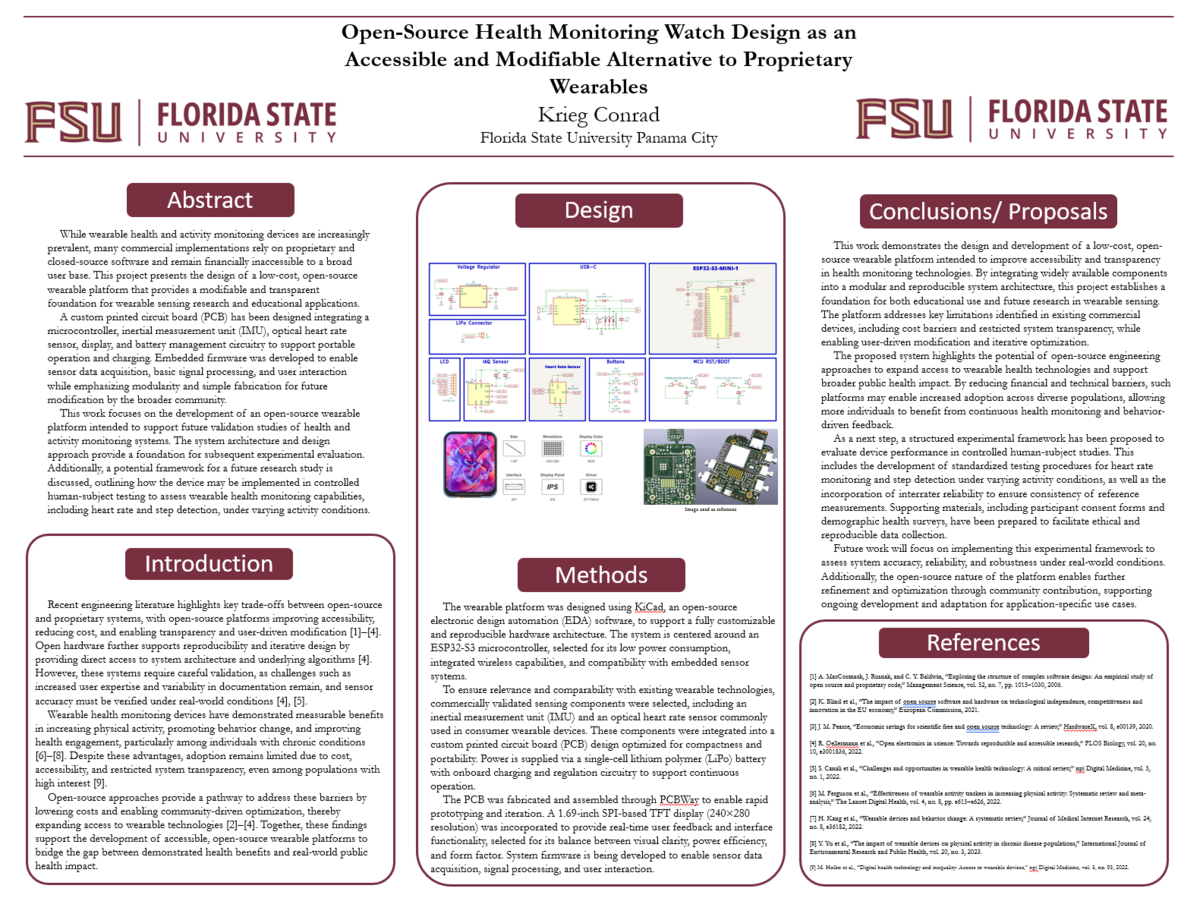
Open-Source Health Monitoring Watch Design as an Accessible and Modifiable Alternative to Proprietary Wearables
Authors: Krieg Conrad, Twan CapehartStudent Major: Krieg Conrad - Mechanical Engineering
Mentor: Twan Capehart
Mentor's Department: Mechanical Engineering Mentor's College: Florida State University Co-Presenters:
Abstract
While wearable health and activity monitoring devices are increasingly prevalent, many commercial implementations rely on proprietary and closed-source software and remain financially inaccessible to a broad user base. This project presents the design of a low-cost, open-source wearable platform that provides a modifiable and transparent foundation for wearable sensing research and educational applications.
A custom printed circuit board (PCB) has been designed integrating a microcontroller, inertial measurement unit (IMU), optical heart rate sensor, display, and battery management circuitry to support portable operation and charging. Embedded firmware was developed to enable sensor data acquisition, basic signal processing, and user interaction while emphasizing modularity and simple fabrication for future modification by the broader community.
This work focuses on the development of an open-source wearable platform intended to support future validation studies of health and activity monitoring systems. The system architecture and design approach provide a foundation for subsequent experimental evaluation. Additionally, a potential framework for a future research study is discussed, outlining how the device may be implemented in controlled human-subject testing to assess wearable health monitoring capabilities, including heart rate and step detection, under varying activity conditions.
Keywords: health monitoring, proprietary technology, open source technology, wearables